Showing posts with label 12th math.. Show all posts

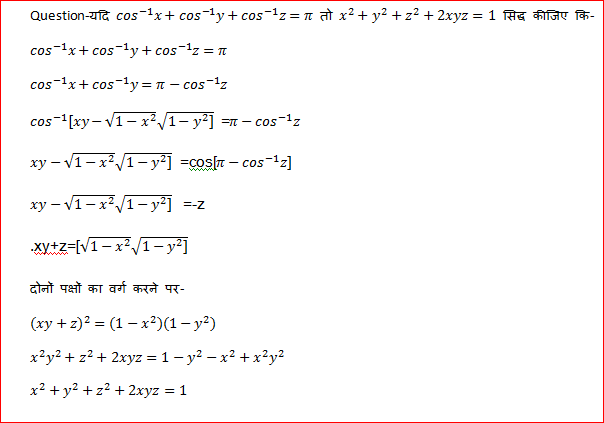
Inverse Circular Function

Inverse Circular Function

Inverse Circular Function

Inverse Circular Function


    1.Introduction to Inverse Circular Function-

    यदि sin𝜽=xहो तो हम x को 𝜽का ज्या(sine) कहते हैं और 𝜽संख्या xका ज्या प्रतिलोम (sine inverse) कहलाता है.इस कथन को गणितीय संकेतन में निम्न प्रकार से लिखा जाता है: 
    𝜽=sin-1x या  𝜽=arcsinx
    sin-1xको हम ज्या व्युत्क्रम(sine inverse) पढते हैं.

    2.प्रतिलोम वृत्तीय फलन(Inverse circular Function):

    हम जानते हैं किsin𝜽,cos𝜽,tan𝜽 इत्यादि त्रिकोणमितीयवृत्तीय फलन(Inverse Circular Function) कहलाते है.,जिनमे से प्रत्येक,𝜽के प्रत्येक मान के लिए एक निश्चित संख्या के बराबर होता है.यदि sin𝜽=xतो 𝜽=sin-1x  होगा.
    कोण 𝜽कोx के रूप में व्यक्त करनेवाला व्यंजक sin-1x  प्रतिलोम वृत्तीय फलन(Inverse Circular Function) है.इसी प्रकार कोण𝜽को,,एक संख्या xके रूप में व्यक्त करने वाले अन्य प्रतिलोम वृत्तीय फलन है.
    Cos-1x,tan-1x,cos-1xतथा cot-1x
    टिप्पणी: 
    1.sin-1x,cos-1x  फलनों में -1 घात नहीं है,इसे केवल प्रतिलोम फलन के संकेत के रूप में प्रयोग किया गया है क्योंकि (sinx)-1=1/sinx अत: sin-1x not equal to (sinx)-1
    2.sin-1x एक कोण को व्यक्त करता है.जबकि sin𝜽 एक संख्या को,जहां  𝜽 एक कोण है.
    प्रतिलोम वृत्तीय फलन: हम जानते है कि किसी फलन f का प्रतिलोम फलन f-1 ज्ञात करने के लिए फलन f ज्ञात करने के लिए  फलन f का एकैकी-आच्छादक होना आवश्यक है.
    वृतीय फलनों के अध्ययन से स्पष्ट है है कि ये फलन अपने स्वाभाविक (सामान्य)प्रांत और परिसर में एकैकी तथा आच्छादक नहीं होते हैं.अत:इनके प्रतिलोम सामान्य स्थितियों में ज्ञात करना संभव नहीं होता है,परंतु इन फलनों के प्रांत को परिसीमित (प्रतिबंधित) करने पर ये फलन एकैकी आच्छादक हो जाते है तथा इन स्थितियों में इनके प्रतिलोम फलन ज्ञात किये जा सकते है.
    3.इन प्रतिबंधित स्थितियों के प्राप्त प्रतिलोम वृत्तीय फलनों के प्रांत एंव परिसर निम्न सारणी में दर्शाये गये है.साथ ही प्रत्येक परिसर खण्ड के लिए हमें प्रतिलोम फलन की एक शाखा प्राप्त होती है.इन शाखाओं में से ही एक मुख्य शाखा होती है .
    Function y=
    Range
    Principal vaue
    Sin-1x
    X=[-1,1]
    [-𝜋/2,𝜋/2]
    Cos-1x
     x𝜖[-1,1]
    [0,𝜋]
    Tan-1x
     X𝜖R     
    (-𝜋/2,𝜋/2)
    .cot-1x
    x𝜖R
    (0,𝜋)
    .sec-1x
    x𝜖R-(-1,1)
    (0,𝜋]-𝜋/2
    .cosec-1x
    x𝜖R-(-1,1)
    [-𝜋/2,𝜋/2]

    टिप्पणी-
    .y=f(x)जैसे व्युत्क्रमणीय फलन का प्रतिलोम फलन x=f-1(y) प्राप्त होता है.अर्थात मूल फलन के आलेख में  Xतथा Y-अक्षों का परस्पर विनिमय करके प्रतिलोम फलन का आलेख प्राप्त होता है.यही नियम प्रतिलोम वृत्तीय फलनों के आलेख प्राप्त करने में लागू होता है.
    (1.)जब कभी प्रतिलोम वृत्तीय फलनों की किसी शाखा विशेष का उल्लेख न हो तो हमारा तात्पर्य उस फलन की मुख्य शाखा से होता है.
    (2.)किसी प्रतिलोम वृत्तीय फलन का वह मान जो उसकी मुख्य शाखा में स्थित होता है प्रतिलोम वृत्तीय फलन का मुख्य्मान(PrincipalValue) कहलाता है.

    4.व्यापक मान (General Value):

    हम जानते हैं कि sin𝜽=sin{n𝜋+(-1)-1𝜽}जहांn𝜖Z पूर्णांक संख्याओं का समुच्चय है.अब यदि 
    sin-1x=𝜽  हो तो sin-1x का व्यापक मान n𝜋+(-1)nsin-1x होता है तथा इसे Sin-1x से निरूपित किया जाता है.अत: Sin-1x=n𝜋+(-1)n sin-1x, n𝜖Z
    इसी प्रकार Cos-1x=2n𝜋+cos-1x, n𝜖Z  ,Tan-1x=n𝜋+tan-1x
    जहां Cos-1x,Tan-1x से हमारा तात्पर्य cos-1x,tan-1x के व्यापक मान से है.इसी प्रकार 
    Sec-1x,Cosec-1x,Cot-1x  से हमारा तात्पर्य sec-1x,cosec-1x,cot-1x के व्यापक मान से होगा.

    5.मुख्य मान (Principal Value):

    प्रतिलोम वृत्तीय फलन(Inverse Circular Value) का मुख्य्मान 𝜽का वह छोटे से छोटा धनात्मक या ऋणात्मक मान है जो समीकरण sin𝜽=x,cos𝜽=xइत्यादि को संतुष्ट करता है
    टिप्पणी-
    (1.)यदि x>0है तब सभी प्रतिलोम वृत्तीय फललों के मुख्य्मान प्रथम चतुर्थांश [0,𝜋/2] में स्थित है.
    No. Social Media Url
    1. Facebook click here
    2. you tube click here
    3. Twitter click here
    4. Instagram click here
    5. Linkedin click here
    (2.)यदि x<0है तब तथा के मुख्यमान चतुर्थ चतुर्थांश[-𝜋/2,0] में स्थित है,जबकि के मुख्यमान द्धितीय चतुर्थांश[𝜋/2,𝜋] में स्थित होते हैं.


    Read more

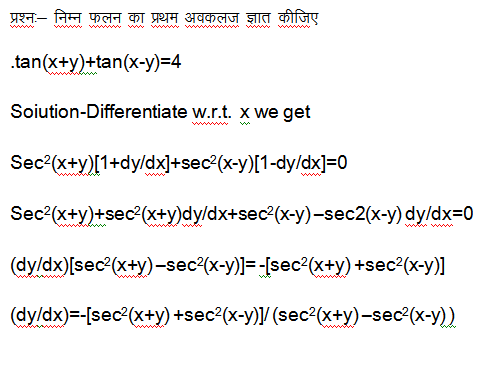
    First Order Derivatives

    First Order Derivatives

    1.प्रथम कोटि का अवकलज(FirstOrder Derivatives)-

    First Order Derivatives

    First Order Derivatives

    माना कि y=f(x)चर राशि x का कोई संतत फलन है,जहाँ x स्वतंत्र तथा y आश्रित चर राशियाँ है.चूँकि y का मान x के मान पर आश्रित है,अत:x के मान में जब कोई परिवर्तन करते हैं तो y के मान में भी परिवर्तन होगा.
    जब किसी चर राशि के एक मान से दूसरे निकटतम मान में भी परिवर्तन होता है,तब इन दोनों मानों के अंतर को ‘वृद्धि’(Increment) कहते हैं.उदाहरणार्थ चर राशि x के दोनों मान x+dx और x के अंतर को x में वृद्धि कहते हैं.इस वृद्धि को dx से व्यक्त करते हैं.
    चूँकि काy  मान x के मान पर आश्रित है अत: यदि x के मान में कोई स्वेच्छ(Arbitrary) अल्प वृद्धि dx की जाय तो y के मान में संगत वृध्दि होगी ,तो भिन्न(dy/dx) की सीमा जब dx→0अर्थात(dy/dx) (यदि विद्यमान हो )को y का x  के सापेक्ष अवकलज या अवकल गुणांक (Differential Co-efficient)कहते हैं.इसे(dy/dx) से व्यक्त करते है-अर्थात यदि-
    .   y=f(x)
    Then y+dy=f(x+dx)
    Dy=f(x+dx)-f(x)
    (dy/dx)= [f(x+dx)-f(x)]/dx

    2.अवकलन(Differentiation)- –

    किसी किए हुए फलन f(x) का अवकल गुणांक ज्ञात करने की प्रक्रिया को अवकलन कहते हैं.यहाँ यह ध्यान रखने की बात है कि(dy/dx) एक भिन्न नहीं है बल्कि प्ररिवर्तन की सीमा को दर्शाने का संकेत है.
    प्रश्न-निम्न फलन का के सापेक्ष अवकलन ज्ञात कीजिए-
    Solution-log(secx+tanx)
    . y=log(secx+tanx)
    . (dy/dx)=(1/secx+tanx)x(secx tanx+sec2x)
    .(dy/dx)=[secx tanx+sec2x]/secx+tanx
    . (dy/dx)=secx(secx+tanx)/secx+tanx
    .  (dy/dx)=secx

    Read more

    solution of a question of inverse circular functions

    Solution of a Question of Inverse Circular Functions

     त्रिकोणमितीय फलन(Inverse Circular Function)-

    हम जानते हैं कि Sin𝜽,Cos𝜽,tan𝜽 इत्यादि त्रिकोणमितीय फलन(Inverse Circular Function) कहलाते हैं ,जिनमें से प्रत्येक,𝜽के प्रत्येक मान के लिए एक निश्चित संख्या के बराबर होता है।
    यदि sin𝜽=xतो𝜽=Sin-1x  होगा।
    solution of a question of inverse circular functions

    solution of a question of inverse circular functions


    Read more

    Derivative of a Function of Functions (Chain rule of Derivative) .

    (1.)Derivative of a Function of Functions OR  Chain Rule of Derivative

    (2.)Standard Formulas Of Derivative


    Derivative of a Function of Functions (Chain rule of Derivative)

    Derivative of a Function of Functions (Chain rule of Derivative

    Derivative of a Function of Functions (Chain rule of Derivative)

    Derivative of a Function of Functions (Chain rule of Derivative


    Read more

    Applications of Maxima and Minima

      Applications of Maxima and Minima

    Application of Derivatives

    Applications of Maxima and Minima

    Applications of Maxima and Minima 

    Applications of Maxima and Minima

    Applications of Maxima and Minima 


    Applications of Maxima and Minima

    Applications of Maxima and Minima 


    Read more

    Rule of integration by parts | integration of product of functions

    Rule of integration by parts or integration of product of functions                      

    Rule of integration by parts , integration of product of function

    Rule of integration by parts or integration of product of  functions                        


    Rule of integration by parts | integration of product of functions

    Rule of integration by parts  or  integration of product of functions 

    Read more

    Integration Of Irrational algebraic Function

    Read more

    Differentiation of a function with respect to another function

    Read more

    Definite Integration by substitution method

    Read more

    Integration of parts

    Read more

    Derivative of a function of functions

    Read more

    Differential equation

    Read more

    Limits and continuity

    Read more

    Differential Equation

    Read more

    Integration of parts

    Integration of parts 

    Integration  of parts

    Integration  of parts 


    Read more

    Differential Equation

    Read more

    Definite Integration by substitution method

    Read more

    Logarithmic differentiation

    Read more

    Differentiation of Implicit function

    Read more